Adhesive labels for bottles look simple on a shelf, but they have to survive a lot: curved surfaces...
View MoreLow-Temperature Freezer Adhesive Labels for Frozen Food | Custom Printed Copper Paper, Synthetic Pap...
View MoreWalk down any supermarket spice aisle and the labels do a lot of quiet work. They tell you whether ...
View MoreDouble Sided Adhesive Tape: PP Base Tape for Cotton Bale Strapping & Coated Paper Double Sided T...
View MoreChoosing an adhesive for labels sounds like a small decision until the first pallet comes back with...
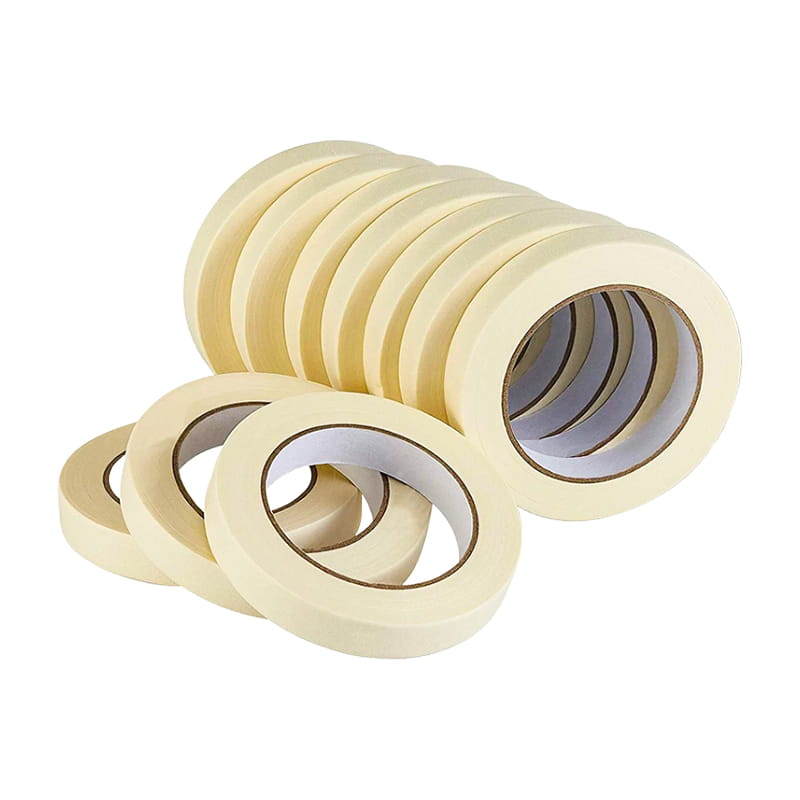
View MoreZhejiang Guanma Packaging Co., Ltd. is a self-adhesive paper and film manufacturer based in Jiaxing, Zhejiang, close to Shanghai, with more than ten years in label stock production. Crepe paper is the conformable, paper-based branch of our Label Solutions range: a creped tissue face that stretches around curves, takes adhesive into its fibrous surface and gives packaging a soft, tactile character that film cannot imitate. We supply it as custom slit rolls, blank die-cut labels or printed finished labels, with the adhesive and release liner matched to the job.
As a Crepe Paper Label Material manufacturer working from Zhejiang, China, we treat crepe paper as a specialty paper face rather than a commodity sheet. Creping compresses the tissue into fine irregular folds, so the sheet carries reserve stretch; a label can follow a compound curve, a shoulder radius or a crease without lifting at the edges. That is what separates it from a flat woodfree or semi-gloss paper of the same weight.
The range we produce here is built around High-Temperature Resistant Crepe Paper, a grade developed for labels that meet heat during filling, sealing, curing or service. It keeps the crepe texture and conformability of the base sheet while resisting the degradation that standard crepe paper shows at elevated temperature. Surface material and adhesive are selected together for the destination climate and the application, which matters when the same product ships to cold stores in one market and hot warehouses in another.
The distinction worth holding onto: crepe paper is chosen for conformability, texture and a paper-based construction. It is not a barrier film, and it will not out-perform a PE or PET face on water, abrasion or long outdoor exposure.
Each order is a build rather than a single article number. The table sets out the elements we combine and what each one changes downstream.
| Build element | What we supply | Effect on converting or application |
|---|---|---|
| Face stock | High-temperature resistant crepe paper; creped tissue in natural paper shade | Stretch and conformability, heat tolerance in service, matte textured print surface |
| Adhesive | Acrylic, hotmelt, solvent-based, removable, permanent UV-curable | Initial tack, ultimate peel strength, cold and heat behaviour, residue on removal |
| Release liner | Matched to the adhesive and to hand or automatic application | Dispensing stiffness, curl on small labels, kiss-cut depth, peel at the applicator |
| Format | Custom slit rolls, blank die-cut labels, printed finished labels | Fit to the applicator, line speed, waste, changeover time |
| Print process | Flexographic, screen, UV, digital, offset | Ink laydown on a textured sheet, white opacity, achievable fine detail |
Crepe paper is still paper. Where the label has to survive water immersion, repeated abrasion, freezer condensation or months of direct sunlight, the correct answer is a film construction — our Outdoor Application Label Material range carries UV-resistant PVC and PE faces for exactly that work. For labels that go on before a vulcanising or curing cycle, Tyre Label Material is the right platform. We would rather route a project to the correct face than push a paper stock into a film job.
A creped sheet is porous, so the adhesive does more work than it does on a smooth film: it penetrates the fibre, forms a mechanical key and then has to hold against the memory of the paper trying to return to flat. The adhesive family is chosen against substrate, application temperature and service life, not by habit.
The liner is not cosmetic. A heavier release paper holds small labels flat through the peel plate; a lighter one suits high-speed dispensing. We set release level against the applicator you run and the label size you cut, so the label leaves the liner cleanly instead of curling or flying.
The crepe texture is a printing variable. Fine halftones and small type soften on the folds, while solid areas, screen white and bold line work sit well and give the label its characteristic matte density. We choose the process against the artwork rather than the other way round.
Die cutting a compressible face needs the cut set against the liner, not the face: the blade has to pass through the crepe reliably without scoring the release paper. Slitting width, core diameter, wind direction and maximum roll diameter are set to your applicator, and width, repeat length and die-cut position are agreed before the run and inspected against that agreement during production.
Crepe paper reacts to moisture before it reacts to anything else. A roll that has taken up damp will cockle on press and curl after application, so storage practice is part of the specification.
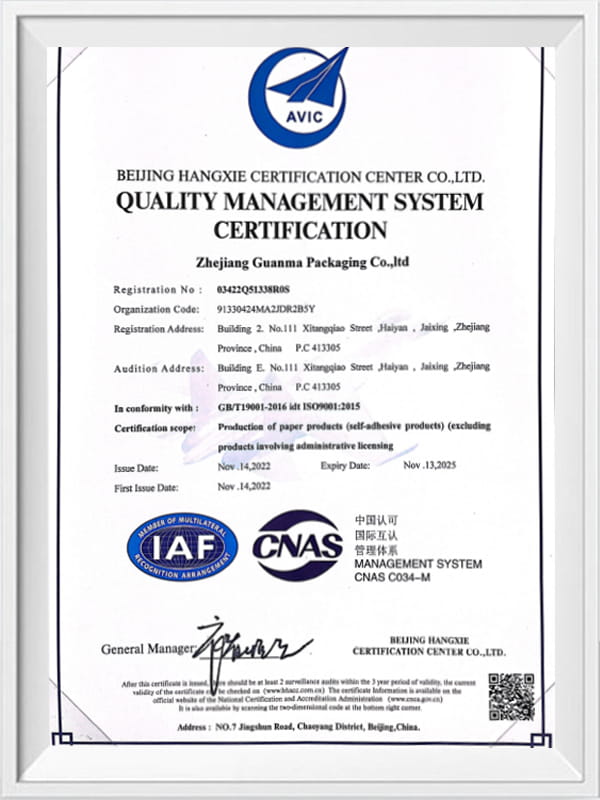
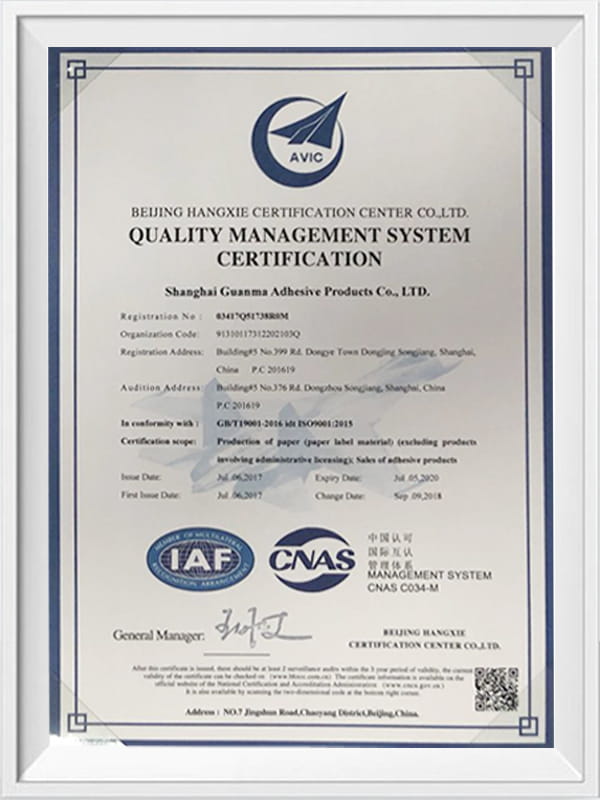
We run a complete quality management system, certified to ISO 9001, and the certification is available for supplier qualification files. Control runs from incoming base paper through adhesive coating and lamination to die cutting and slitting, so that the roll that leaves the building carries the same build that was approved.
Acceptance criteria are agreed per order — face stock grade, adhesive, coat weight, liner, cut depth, roll width, splice condition and pack quantity — and inspected against that agreement. Where your own line does the final check, we work to the same criteria so that a roll accepted on our floor is a roll accepted on yours.
A crepe paper specification is settled by the working conditions, not by a catalogue page. These are the inputs that change the build.
| Project input | What it determines |
|---|---|
| Substrate and surface condition | Adhesive family and coat weight; whether a primer or a removable system is needed |
| Temperature profile | Crepe grade, adhesive and liner; behaviour through filling, storage and service peaks |
| Application method and speed | Release level, roll format, splice policy, labels per roll |
| Artwork and print process | Face stock grade, ink sequence, achievable detail on the crepe texture |
| Roll format | Slit width, core diameter, wind direction, maximum roll diameter |
| Volume and repeat pattern | Run length, slitting plan, blank stock versus printed finished labels |
| Exposure and destination climate | Adhesive and liner for humidity, cold chain or hot storage; whether a film face is the better route |
Finished rolls are wound on the agreed core, protected for transit and packed to the roll count and pallet pattern confirmed at order. Roll labels carry width, adhesive and liner reference so a roll can be identified on the line without unwinding it. Blank die-cut labels and printed finished labels ship in the same programme, which lets one purchase order cover both a stock item and a printed edition from a single factory.
They are used where a label has to sit on a curve, a shoulder or an irregular surface and where a soft matte paper finish is part of the product look: bottles and tubes, gift and hamper packaging, artisan and specialty retail goods. Heat-resistant crepe grades also serve positions close to a sealing, curing or drying stage.
It depends on the grade, the adhesive, the dwell time at temperature and whether the heat is continuous or a short peak. Send us the temperature at application, the service temperature and how long the label sits at each, and we will confirm which crepe build suits the profile before quoting.
Yes. We run flexographic, screen, UV, digital and offset printing and carry slitting and die cutting in house, so we deliver custom slit rolls for your own press, blank die-cut labels, or fully printed finished labels ready for application.
There is no single answer: acrylic suits general permanent work, hotmelt gives high initial tack on fibrous or dusty surfaces, solvent-based systems handle humidity and cold, removable grades protect returnable packaging, and permanent UV-curable adhesive fits lines already running UV. The substrate and temperature profile decide it.
Slit width, core diameter, wind direction, maximum roll diameter and labels per roll are set to your applicator. Send the unwind direction and the roll diameter your machine accepts, and the slitting plan is built around it.
The paper fibre is recyclable, but the whole label's fate depends on the adhesive, the liner and the ink system, and on what your local recycling stream accepts. Water-based acrylic adhesive and a paper liner keep the construction closest to a paper recovery route; we confirm the build against the disposal route you are working to.
Address : Building 2. No.111 Xincheng Road, Xitangqiao Street, Haiyan, Jiaxing, Zhejiang Province, China
Phone: +86-150 0573 0249
Tel: + 86-0573-8685 2732
Fax: + 86-0573-8685 2732
E-mail: [email protected]
Copyright© Zhejiang Guanma Packaging Co., Ltd.
 Privacy
Crepe Paper Label Material Manufacturers Wholesale Crepe Paper Labels Suppliers Crepe Paper Labels Factory


 English
 русский
 Español
 عربى