

 English
 русский
 Español
 عربى
Home / News / Industry News / Clear Adhesive Labels: Choosing Transparent Film, Adhesive, and Print Options
Clear adhesive labels are one of those packaging details that look effortless and are not. A transparent label on a glass bottle, a cosmetic jar, or a window decal can disappear into the surface, but only when the face film, adhesive, liner, and print method are working together. In our work supplying self-adhesive label materials, we have learned that most clear-label problems begin long before the press runs. They begin with a material choice that looked right on a sample sheet but behaved differently on the actual container.
Content
In everyday language, a clear adhesive label is a transparent film label that lets the container, product, or background show through. In material terms, “clear” can mean several things: optically clear, slightly frosted, glass-like, or simply colorless. A clear label is not a white label without printing. It is a film face stock, an adhesive, and a liner chosen together so the label remains visually quiet after application.
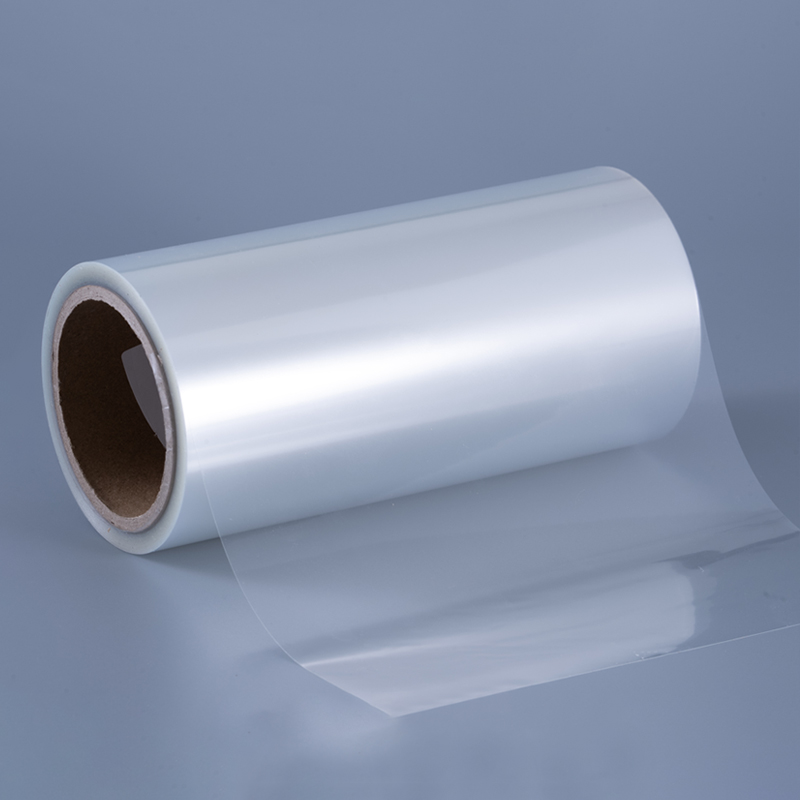
Transparent PET and clear PP are the two most common face films for this job. Transparent PET gives a crisp, rigid feel and good dimensional stability. Clear PP is softer and more flexible, which helps on squeezable bottles and curved tubes. The adhesive also has to wet out cleanly. If it is too stiff or the liner releases unevenly, the label can trap air, lift at the edges, or look cloudy even when the film itself is transparent. Clear-on-clear constructions also depend on a smooth liner; a rough or mismatched liner can leave marks that are difficult to remove.
Where the label needs to follow a squeezable bottle or a cosmetic tube, a transparent PP film is often a friendly starting point because it is flexible and keeps the container visible.
 Transparent PP Label Film for Cosmetics and Daily LabelsA 50um clear PP film with acrylic adhesive and glassine liner, suited to flexible cosmetic and daily-use labels where container visibility matters.View Product →
The right film depends on what the label must do. A flat glass bottle, a curved shampoo bottle, a freezer pack, and an outdoor equipment panel put different demands on the same transparent face stock. For converters comparing transparent PET film options, it helps to look beyond “clear” and consider thickness, stiffness, surface coating, and the ink system the label will meet.
PET is often chosen when the label needs a premium glass-like look, good heat resistance, or stable performance on flat surfaces. PP is often chosen when flexibility and cost control matter more than rigidity. A coated clear film may print beautifully on one inkjet press and poorly on another, so the topcoat and ink compatibility deserve a real test rather than a quick sample print. For more background on transparent PET grades, see our transparent PET film options.
| Face material | Look and feel | Strong fit | Watch-outs |
|---|---|---|---|
| Transparent PET | Crisp, stiff, glass-like | Premium bottles, durable labels, outdoor and warm conditions | Can be less conformable on tight curves; confirm ink adhesion |
| Clear PP | Softer, flexible, light | Squeeze bottles, tubes, personal care, wet-wipe style packaging | Can stretch during dispensing; test die-cutting and edges |
| Coated clear film | Smooth, receptive, print-ready | Clear printable labels for inkjet, laser, or digital work | Topcoat and white ink can affect final clarity; test first |
Thickness is part of the same decision. A thicker film may stand up straighter on a flat panel, while a thinner film may follow a curve more gracefully. There is no universal “best” clear label material. There is only the material that suits the surface, the application method, and the life the label must live.
Clear labels are unforgiving about adhesive. A white paper label can hide a little haze, a small bubble, or a slightly visible adhesive edge. A transparent label cannot. Water-based acrylic adhesives are common for general labeling and can offer a clean, controlled bond on many surfaces. Solvent acrylic adhesives are often selected when better initial tack, chemical resistance, or performance on difficult surfaces is needed. Rubber-based adhesives can be useful for high initial grab, while removable adhesives need a clean release without leaving a shadow behind.
Outdoor jobs may call for a UV adhesive and a stable PET face; the combination has to resist sunlight, moisture, and temperature swings without turning milky or lifting at the edges.
 50um Transparent PET Film with UV AdhesiveA clear 50um PET film with UV adhesive and white glassine liner, a candidate for outdoor labels where long-term transparency matters.View Product →
Surface energy is the quiet variable. Glass, PET, PP, powder-coated metal, and recycled plastics do not pull on the same adhesive in the same way. A clear label that sticks beautifully to smooth glass may fail on a low-surface-energy plastic or a slightly textured bottle. For a deeper look at how adhesive strength and surface suitability interact, our guide to adhesion strength and surface suitability is a useful next read.
Temperature matters too. Freezer labels need an adhesive that remains tacky in cold, damp conditions. Outdoor labels need to survive heat, cold, and sunlight. Removable clear labels need to release cleanly after weeks or months without leaving a cloudy residue. In each case, the adhesive is not an accessory to the film. It is half of the label system.
Clear printable labels are popular for short runs, brand trials, and product personalization, but transparent film is less forgiving than white paper. Many clear films need a print-receptive topcoat to hold ink evenly. Without it, ink can bead, scratch, or look uneven under light. The print method also changes the result. Flexo, screen, UV digital, water-based inkjet, and laser printing all interact differently with clear film.
For clear labels, “printable” does not mean “printable on every press.” A coated clear PET for inkjet, a clear PP for flexo, and a polyester film for laser printing each have their own best use. The safest path is to match the film and coating to the actual print engine, then test the printed label on the real container.
Clear labels are not only a cosmetic choice. They can make a product feel integrated with its packaging, but they can also solve practical problems where a white label would be visually intrusive. Common applications include:
In every case, the label should be tested on the actual surface and in the actual environment. A clear label that looks perfect in the sample room can still fail in a cold chain, a humid bathroom, or a hot car.
When a customer asks for a clear adhesive label, the most useful conversation is specific. A simple checklist keeps the project grounded:
It also helps to agree on what “clear” means for the project. A slight frost may be acceptable on a shampoo bottle but not on a premium glass bottle. A very thin film may follow a curve beautifully but prove difficult to dispense at speed. These are not small details; they are the difference between a label that disappears and one that looks like an afterthought.
Clear adhesive labels reward patience. The best results come from treating the face film, adhesive, liner, print coating, and application surface as one system rather than a list of separate parts. At Zhejiang Guanma Packaging, we supply self-adhesive paper and film materials in jumbo rolls for converters and label printers, and we have seen how often a small material adjustment solves a problem that looked like a printing issue. Start with the container, define the environment, test the print, and choose the adhesive for the life the label must lead. When those pieces line up, a clear label can do what it does best: stay visible only when you want it to be.
We have a professional R&D team and strong manufacturing capabilities to ensure product quality and delivery while doing a good job in product iteration and innovation.
Address : Building 2. No.111 Xincheng Road, Xitangqiao Street, Haiyan, Jiaxing, Zhejiang Province, China
Phone: +86-150 0573 0249
Tel: + 86-0573-8685 2732
Fax: + 86-0573-8685 2732
E-mail: [email protected]
Copyright© Zhejiang Guanma Packaging Co., Ltd.
 Privacy
OEM Self Adhesive Label Material Manufacturers Waterproof Labels Suppliers Custom Adhesive Label Material Factory