

 English
 русский
 Español
 عربى
عربى
Home / News / Industry News / How to Select Labels for Frozen Food Packaging: Face Stock, Adhesive & Printing Guide
Content
A Guide to Face Stock, Adhesive and Printing Method Selection
Original English Version: v3 | Purpose: Internal Review & Publication Preparation Terminology standardized for pressure-sensitive label materials, label printing and frozen-food packaging applications
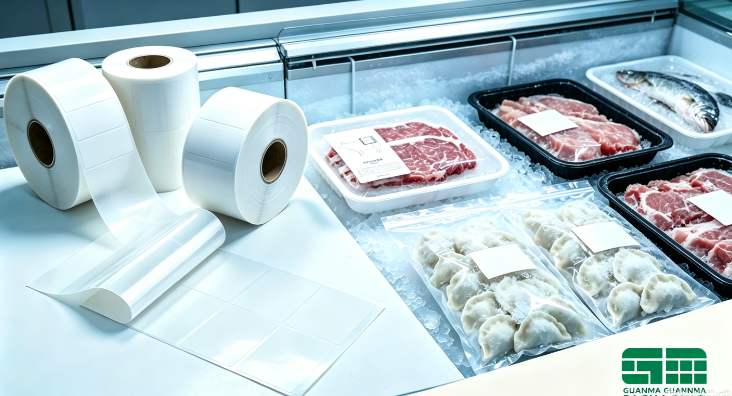
To choose suitable labels for frozen-food packaging, you need to match face stock, adhesive and release liner as a complete system based on packaging type, application temperature, storage conditions and printing method. Testing should use the full label construction and actual packaging units, rather than simple hand-application onto clean room-temperature samples only.
“Frozen-food label” describes an intended end-use, not one universal material construction. Before comparing materials, clarify what substrate the label will adhere to, plus all conditions before, during and after label application.
Answer these key questions first: Is the packaging a PE or PP tray, flexible pouch, coated carton, rigid cup/tub, or another format? Are labels applied before cooling, inside a low-temperature production area, or onto already frozen packages? Is the application surface dry, damp, oily, frosted, or uneven? Does the packaging bend, shrink or expand during filling and freezing cycles? Will variable data be printed via direct thermal or thermal transfer printing? How long must barcodes, batch codes and product information remain legible?
Your answers determine whether thermal paper, thermal synthetic paper, pearlescent PP or custom film works good as your starting face stock — and which adhesive grade you require. Selecting face stock alone without evaluating adhesives may result in labels that print well but lift off packaging, or high-tack products that cause constant manufacturing issues.
Refer to our general food-label guide for broader food-packaging applications. Continue reading this guide if your priority is label performance under refrigerated and frozen conditions.
Confirm both parameters before requesting material samples.
Application Temperature: The actual temperature of both the label and packaging surface at the moment of labelling. Low temperatures reduce an adhesive’s ability to wet out the substrate; moisture or frost creates a barrier between adhesive layer and packaging surface.
Service Temperature: The temperature range the finished label must withstand during storage and end-use once a bond has formed. A label that performs well for frozen storage when applied to warm, clean packaging can still fail if applied directly onto pre-frozen trays.
This distinction defines three common production scenarios:
Do not approve a label purely based on low service temperature figures on data sheets. Always verify the small application temperature and replicate real-world production conditions during testing.
For one fresh-tray project, a customer trialled multiple label materials without achieving satisfactory results. Some failed to adhere reliably to plastic trays; others created new complications during processing and end-use.
Our recommended construction delivered consistent adhesion while maintaining clean performance through die-cutting, printing and labelling. No adhesive oozed from label edges; no adhesive transfer occurred onto thermal-transfer ribbons, and no residue built up on print heads. Finished labels operated flawlessly during customer-side dispensing and automatic labelling.
This demonstrates that you are not simply purchasing “higher tack”. You require a balanced pressure-sensitive label system: sufficient initial tack for your substrate, adequate adhesive cohesion to prevent oozing, stable release properties, clean die-cutting, and reliable runnability across printers and labelling equipment.
Evaluate the full processing and service lifecycle when testing samples. Even samples that perform adequately after manual application may fail during die-cutting, high-tension rewinding, high-speed printing or automatic dispensing.
Use this table to short-list samples for initial trials. Final construction validation must take place on real packaging substrates and live production lines.
|
Packaging & Process |
Recommended Starting Construction |
Rationale |
Key Test Items |
|
Fresh food PE/PP trays requiring variable data printing |
75 μm thermal synthetic paper / freeze-grade adhesive / glassine liner |
Higher moisture resistance than standard thermal paper; ribbon-free variable-data printing |
Tray resin composition, condensation, edge lifting, image durability, labelling-machine runnability |
|
Dry coated or corrugated cartons for frozen storage |
Thermal paper / freeze-grade adhesive / glassine liner |
Cost-effective option for dry substrates with controlled print-life requirements |
Condensation resistance, abrasion, thermal-image stability, carton-coating compatibility |
|
Flexible PE/PP pouches and frozen-food bags |
60 μm pearlescent PP / freeze grade adhesive / glassine liner |
Moisture-resistant film that accommodates moderate packaging deformation better than rigid paper |
Pouch wrinkling, low-surface-energy substrates, seal zones, package distortion, label dimensional stability |
|
Rigid PP cups, frozen-food tubs and ice-cream containers |
60 μm pearlescent PP / freeze grade adhesive / glassine liner |
Balances moisture resistance with high-quality printable surfaces for retail shelf presentation |
Curved-surface performance, frost exposure, grease resistance, container deformation, edge lifting |
|
Meat and seafood trays with thermal-printed variable data |
75 μm thermal synthetic paper / freeze grade adhesive / glassine liner |
Superior moisture resistance compared to standard paper for variable-data labelling |
Grease, moisture, surface coatings, low-temperature adhesion, barcode legibility, food-contact considerations |
|
Pre-frozen or visibly frosted packaging |
Custom freeze label construction validated by physical testing |
Fast initial tack required under genuine low-temperature and contaminated-surface conditions |
Frost severity, application pressure, bond-formation time, freeze-thaw cycles, surface contamination |
Visit our dedicated resource pages for thermal synthetic paper labels, PP film labels and thermal-paper labels to learn more about these face-stock categories.
PE and PP trays are typically harder substrates for adhesion due to low surface energy. Mould-release agent residues, surface texture and condensation all alter bonding performance. Always test using real product-filled trays at actual line-side temperatures. Re-validate label performance if you change tray suppliers or resin formulations.
Pouches bend and flex during filling and handling. Stiff paper labels tend to bridge wrinkles and lift at edges. Thinner PP films are often a strong starting candidate when both flexibility and moisture resistance are required. Position labels away from seal and fold lines, and run tests using product-filled pouches.
Clean, dry cartons are generally easier to label. Nevertheless, surface coatings, dust and condensation still compromise adhesion. Thermal paper delivers an economical solution for well-controlled dry environments. For wet handling exposure, abrasion or extended shelf-life, select more durable face stocks and printing technologies.
Over stiff or over-sized labels on curved cups will attempt to return to their flat original shape, resulting in edge lifting. Select highly conformable constructions; reduce label width where possible, and inspect bond performance once containers reach final frozen temperatures.
Freeze-formulated adhesives must wet out substrates at application temperature, resist cold and moisture, and possess sufficient internal cohesion to stop edge oozing.
When requesting samples from suppliers, provide evaluation parameters covering: Exact packaging material and surface treatment Minimum application temperature (not only storage temperature) Surface conditions: dry, damp, oily or frosted Label dimensions, substrate curvature and packaging flexibility Intended storage duration and freeze thaw cycles Die-cutting performance and automatic-dispensing line speeds Printer compatibility, ribbon types and risk of adhesive build up on print heads
Higher initial tack does not guarantee clean processing. Excessive adhesive coat weight, poor cohesion, high roll-up tension or inaccurate die-cutting cause edge oozing, web handling faults and print-head contamination.
Refer to our adhesive selection guide to compare grades against real-world application conditions, rather than relying purely on marketing terms such as “permanent” or “super-high-tack”.
Your printing method impacts face stock choice, consumables, image durability and equipment maintenance. Confirm production printing technology before approving a complete label construction.
Direct thermal labels produce imagery via chemical colour change in the thermal coating. No ribbon is needed. Ideal for inline printing of weights, prices, dates, batch codes and barcodes.
Standard thermal paper suits well-controlled, dry-carton applications with short required print lifespans. For damp prone trays or rough handling environments, 75 μm thermal synthetic paper offers improved moisture and tear resistance as a starting point.
Always test thermal image resistance against condensation, abrasion, heat, light, grease and plasticisers, as thermal prints risk darkening or fading over time.
Thermal transfer imagery is formed by melted ribbon ink. With correctly matched face stock and ribbon, printed output delivers very good rub resistance, moisture resistance and long-term archival stability.
When using pearlescent PP or other film face stocks, test ribbons alongside label top-coatings. Wax based, wax-resin hybrid and full resin ribbons behave differently across printer hardware and label surfaces.
Run continuous print trials at near production roll lengths and inspect label edges. Final approval must assess print density, barcode grade, web handling, ribbon compatibility and print-head cleanliness — not only the quality of the printed label.
Test the full label system following your actual production workflow:
Record both passing results and failure modes. If edge lifting occurs, document packaging batch data, temperatures, bond development time and exact failure locations. This enables targeted adjustments to label construction or manufacturing processes.
Do not assume interchangeability. Even trays marketed as PP may differ in surface treatment, texture, additives and surface contamination. Re-validate label performance after switching tray suppliers, resin grades or moulding processes.
Glassine release liners are widely used for roll-form labels, supporting die-cutting, waste-matrix stripping and high-speed automatic dispensing. Verify liner thickness, release force, tensile strength and compatibility with your die-cutting and labelling equipment.
Share packaging material, substrate photos, label dimensions, application and service temperatures, surface conditions, expected storage life, printing technology, printer model, ribbon specification, dispensing orientation, core size and labelling speed. Where available, provide samples from previous unsuccessful trials.
Share details of your packaging, temperature profiles, printing requirements and line-operating conditions. We can recommend suitable starting constructions for physical trials on real products prior to commercial quotation. Submit your application specifications to request frozen-food label samples and RFQ evaluation.
We have a professional R&D team and strong manufacturing capabilities to ensure product quality and delivery while doing a good job in product iteration and innovation.
Address : Building 2. No.111 Xincheng Road, Xitangqiao Street, Haiyan, Jiaxing, Zhejiang Province, China
Phone: +86-150 0573 0249
Tel: + 86-0573-8685 2732
Fax: + 86-0573-8685 2732
E-mail: [email protected]
Copyright© Zhejiang Guanma Packaging Co., Ltd.
 Privacy
OEM Self Adhesive Label Material Manufacturers Waterproof Labels Suppliers Custom Adhesive Label Material Factory