

 English
 русский
 Español
 عربى
عربى
Home / News / Industry News / PP Synthetic Paper for Frozen Food Labels Compatible with Flexographic and UV Digital Inkjet Printing
When a label fails on a frozen food package — peeling off at -25°C, smearing during distribution, or refusing to accept a printed best-before date — the consequences go beyond aesthetics. Regulatory compliance fails, brand credibility suffers, and product traceability breaks down. The solution starts with choosing the right label stock: a polypropylene (PP) synthetic paper specifically engineered for frozen food environments and designed to work seamlessly with both flexographic printing presses and UV digital inkjet systems. This article explains what makes PP synthetic paper the benchmark material for frozen food labels, how its dual print compatibility works in practice, and what specifications matter most when sourcing or specifying this material.
Content
PP synthetic paper is a co-extruded polypropylene film engineered to look, feel, and print like paper while performing like a plastic film in demanding environments. The base structure is a white, opaque polypropylene sheet — typically produced by a biaxially oriented or cast co-extrusion process — with one or both sides coated with a specialized surface treatment that enables ink adhesion. The result is a material that combines the print receptivity of coated paper with the physical resilience of a polymer film.
In frozen food applications, this distinction is critical. Standard paper-based label stocks absorb moisture, lose tensile strength when wet, and become brittle or curl at sub-zero temperatures. PP synthetic paper does none of these things. Its polypropylene core is inherently waterproof — it does not absorb moisture even under prolonged exposure to condensation, ice, or the freeze-thaw cycles that occur every time frozen goods move from cold storage to a warmer distribution step. The material retains its flexibility and dimensional stability at temperatures as low as -40°C to -55°C, which covers the operating range of virtually all commercial frozen food storage and distribution chains.
The coating applied to the surface of PP synthetic paper is equally important. A properly formulated top coat provides the surface energy and micro-texture needed for UV inks — both flexo and inkjet — to wet, spread, and cure correctly. Without this coating, UV inks would bead on the low-energy polypropylene surface and fail to achieve acceptable adhesion. The coating also provides a degree of scuff and chemical resistance on the printed surface, protecting the finished label through the physical abuse of packaging lines, cold store handling, and retail display.
Not every PP synthetic paper is formulated for frozen food service. The material specification must address several performance dimensions simultaneously — cold resistance, moisture resistance, adhesive compatibility, and print surface quality. The table below summarizes the core property requirements for a PP synthetic paper label stock intended for frozen food packaging.
| Property | Requirement | Why It Matters |
|---|---|---|
| Application Temperature | Down to -15°C (labeling); service to -55°C | Labels must apply cleanly to frozen or chilled surfaces and remain bonded throughout the cold chain |
| Moisture Resistance | Waterproof; no moisture absorption | Condensation, ice melt, and wet packaging lines must not cause label failure or print degradation |
| Tear Resistance | Non-tearable / high tensile strength | Protects label integrity through mechanical handling on packaging and fulfillment lines |
| Dimensional Stability | No curl, shrink, or distortion at -40°C | Prevents label lifting, edge curl, and legibility loss in cold storage |
| Surface Energy (Print Receptivity) | ≥38–42 dynes/cm (after top coat) | Ensures UV ink wetting and adhesion on both flexo and inkjet print runs |
| Oil and Chemical Resistance | Resistant to fats, oils, and cleaning agents | Frozen meat, confectionery, and prepared meal packaging involves exposure to food fats and sanitizers |
| Caliper / Thickness | Typically 80–120 µm for label stock | Affects stiffness, die-cutting performance, and label dispenser compatibility |
The facestock — the PP synthetic paper itself — is only half of the label construction. The pressure-sensitive adhesive (PSA) laminated to the back of the material is equally critical, and standard permanent or general-purpose adhesives will fail on frozen food packaging. A frozen-grade label adhesive must perform in two demanding conditions simultaneously: it must apply and tack reliably to a cold substrate (often below 0°C, sometimes below -15°C), and it must maintain a permanent bond through the entire service life of the packaged product at storage temperatures that may reach -40°C or lower.
Frozen-grade PSAs are typically formulated as low-temperature permanent rubber-based hot melt pressure-sensitive adhesives. These are engineered to remain pliable and tacky at temperatures where standard acrylic or solvent-based adhesives become glassy and brittle. Key performance benchmarks for a frozen food label adhesive include a minimum labeling temperature of -15°C, a service temperature range of -55°C to +40°C, and initial adhesion and 90° peel force values certified against relevant standards (e.g., GB/T 2792 for peel adhesion). The adhesive must also bond reliably to the range of surfaces used in frozen food packaging: PE film overwrap, PP trays and boxes, PET bottles, aluminum foil containers, and coated corrugated cartons.
One common field failure is attempting to label a product that has surface frost, condensation, or residual moisture on the packaging. Even the best frozen-grade adhesive has limits — applying a label to a wet or iced surface dramatically reduces initial tack and long-term bond strength. Specifications should include a note that packaging surfaces must be dry and free of ice, oil, or contamination at the point of label application for adhesive performance guarantees to apply.
One of the defining advantages of a properly engineered PP synthetic paper label stock for frozen food is its ability to function in two distinct printing environments: conventional flexographic press runs for base label decoration, and UV digital inkjet printing for variable data — batch codes, best-before dates, net weights, barcodes, and serialized information. This dual compatibility is not automatic; it must be engineered into the material through surface coating chemistry and validated through print trials with both technologies.
In modern frozen food production, labels carry two types of printed content that are produced at fundamentally different stages and in different quantities. Static content — brand graphics, ingredient panels, nutritional tables, regulatory text, and product imagery — is printed in large volumes on flexographic or other conventional presses at the label converter. This content is fixed, does not change between batches, and benefits from the high speed, low per-unit cost, and superior color rendering of flexographic printing. Variable content — lot numbers, production dates, best-before dates, price per weight, and traceability codes — changes with every production run or even every individual package, requiring on-demand printing at the food manufacturer's facility. UV digital inkjet is the technology of choice for this step because it requires no plates, handles variable data natively, and operates inline with packaging equipment at production line speeds.
A PP synthetic paper label stock that supports both technologies allows the label converter to produce beautifully decorated flexo-printed labels in bulk, which the food manufacturer then overprints with variable data using a UV digital inkjet system directly on the packing line. The result is a single label that integrates high-quality brand graphics with accurate, legally required variable information — all on a substrate rated for frozen food service.
Flexographic printing uses flexible photopolymer plates mounted on rotating cylinders to transfer UV-curable or water-based inks onto the substrate as it passes through the press at speeds that commonly exceed 150 meters per minute. For PP synthetic paper, UV flexo inks are the preferred system — they cure instantly under UV lamps integrated into the press, eliminating solvent evaporation issues and providing excellent adhesion to polymer substrates. The top coat on the PP synthetic paper provides the surface energy needed for UV flexo inks to wet correctly and the surface texture needed for ink hold-out and color density. Flexo printing on PP synthetic paper delivers sharp fine-line reproduction, vibrant solid coverage, and excellent ink-to-substrate adhesion that survives the cold and moisture conditions of frozen food handling.
Label converters running UV flexo on PP synthetic paper should verify that the material's surface coating is specifically formulated for UV flexo compatibility — not all coatings designed for offset or water-based flexo perform equivalently with UV ink systems. Ink adhesion tape tests (cross-hatch adhesion per ISO 2409 or equivalent) and rub resistance tests should be part of press approval before full production runs begin.
UV digital inkjet printing uses piezoelectric inkjet print heads to deposit UV-curable ink droplets directly onto the substrate in precise dot patterns driven by digital artwork data. Because no printing plates are involved, the content can change from one label to the next at full production speed — true variable data printing. UV inkjet systems for label overprinting typically operate at resolutions of 600–1200 dpi and can print barcodes, QR codes, alphanumeric text, and simple graphics with the precision and contrast required for automated barcode scanning in food traceability systems.
For UV digital inkjet overprinting to perform reliably on flexo-pre-printed PP synthetic paper, several conditions must be met. The flexo-printed surface must not contain varnish or coating layers that block inkjet ink penetration or adhesion — the overprint area must expose the base top coat of the PP synthetic paper. The UV inkjet system's cure energy and ink formulation must be validated for the specific substrate, because under-cured UV inkjet ink on a non-absorbent polymer surface will smear, transfer, or fail adhesion tests. Surface energy of the print-receiving zone should be confirmed at ≥40 dynes/cm prior to inkjet overprinting to ensure reliable droplet spreading and ink adhesion.
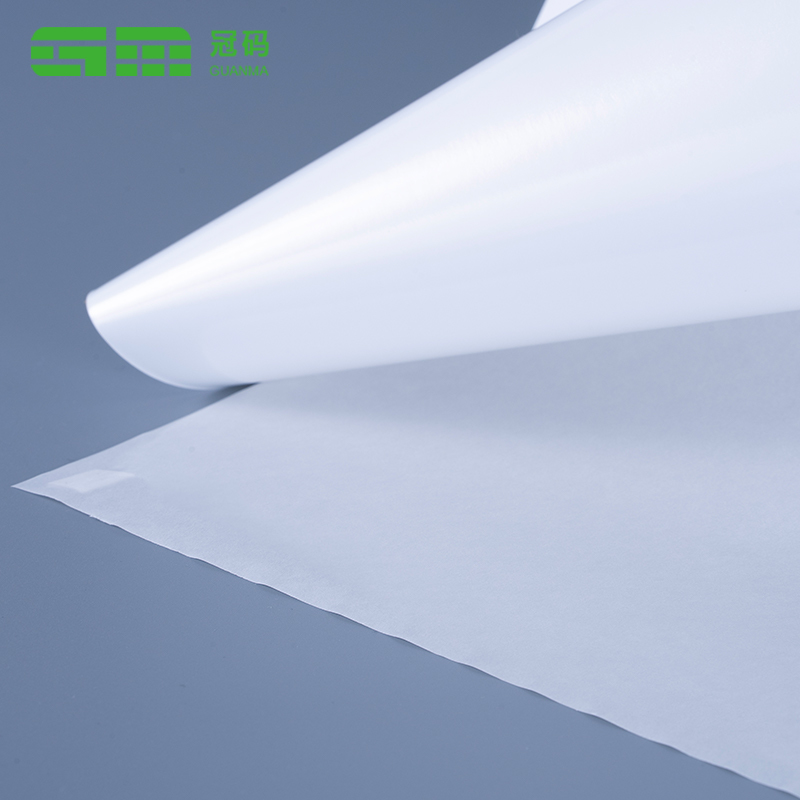
The top coat applied to PP synthetic paper is the component that makes dual print compatibility possible, and its formulation is more technically complex than it might appear. The coating must simultaneously achieve several competing objectives: provide sufficient surface energy for UV ink wetting; offer controlled ink absorption for sharp dot reproduction; resist moisture (so the coating does not swell or delaminate in freezer environments); maintain adhesion to the underlying PP substrate through thermal cycling; and remain compatible with both the UV flexo inks used in press printing and the UV inkjet inks used in overprinting — which may come from completely different ink manufacturers with different resin chemistries.
High-performance PP synthetic paper for dual flexo/inkjet use typically uses a specially formulated acrylic or polyester-based top coat applied at precise coat weights — typically 2–5 g/m² — to achieve the right balance of surface porosity and ink hold-out. The coating is designed with a matte or semi-matte surface finish that diffuses light uniformly (providing a paper-like appearance) while maintaining the dimensional flatness and smoothness needed for consistent ink transfer from both flexo plates and inkjet nozzles. Some premium grades include an additional primer layer between the base PP film and the top coat to improve inter-layer adhesion and ensure the coating system remains intact through freeze-thaw cycling.
PP synthetic paper labels with flexo/UV inkjet compatibility are deployed across the full spectrum of frozen food product categories, each with slightly different performance priorities.
PP synthetic paper is not the only material used for frozen food labels, and understanding how it compares to alternatives helps justify the material selection decision — or identify cases where an alternative might be more appropriate.
| Material | Cold Resistance | Moisture Resistance | Flexo Print Quality | UV Inkjet Compatibility | Cost |
|---|---|---|---|---|---|
| PP Synthetic Paper (coated) | Excellent (to -55°C) | Excellent (waterproof) | Excellent | Excellent (with correct coating) | Medium |
| Paper (with frozen adhesive) | Moderate | Poor (absorbs moisture) | Good | Limited (moisture curl) | Low |
| BOPP Film (clear or white) | Very Good | Excellent | Good (needs corona) | Moderate (ink adhesion risk) | Low–Medium |
| PET Film (polyester) | Very Good | Excellent | Good | Good | Medium–High |
| PE Film (polyethylene) | Good | Excellent | Moderate | Limited | Low |
The key differentiation of PP synthetic paper versus plain BOPP or PE film is its paper-like appearance and print surface. For frozen food products where label design quality matters for retail appeal — premium ready meals, branded meat products, specialty confectionery — the visual and tactile quality of a PP synthetic paper label significantly exceeds what is achievable on clear or white film stocks. The matte top-coated surface of PP synthetic paper also provides better ink hold-out and color density in flexo printing than untreated film substrates, which is why label converters producing high-quality frozen food labels consistently prefer it over commodity film alternatives.
When qualifying a PP synthetic paper material for a frozen food label application that requires both flexographic pre-printing and UV digital inkjet overprinting, the specification process should cover the following points systematically.
We have a professional R&D team and strong manufacturing capabilities to ensure product quality and delivery while doing a good job in product iteration and innovation.
Address : Building 2. No.111 Xincheng Road, Xitangqiao Street, Haiyan, Jiaxing, Zhejiang Province, China
Phone: +86-150 0573 0249
Tel: + 86-0573-8685 2732
Fax: + 86-0573-8685 2732
E-mail: [email protected]
Copyright© Zhejiang Guanma Packaging Co., Ltd.
 Privacy
OEM Self Adhesive Label Material Manufacturers Waterproof Labels Suppliers Custom Adhesive Label Material Factory